Q&A: Fat loss, cholesterol, caffeine, and beating jet lag
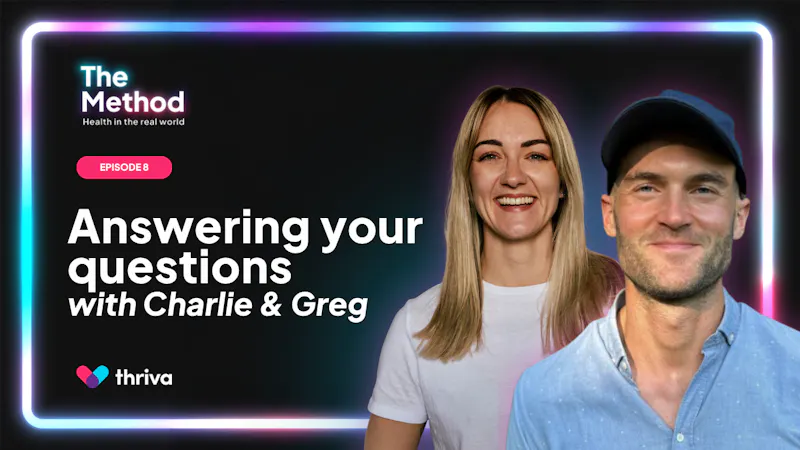

In this special Q&A episode, Charlie and Greg answer your most-asked questions spanning nutrition, caffeine, and sleep.
Show notes
Have you ever written to us and been waiting expectantly for your question to make the cut? Well, it's time we finally answered you.
This week, Greg and Charlie are back behind the mic for something a little different: a special Q&A episode. Over the course of eight episodes, we've gathered a number of fascinating listener questions that don't always fit neatly into the subjects we cover. So today, we give four questions the spotlight they deserve, drawing on Greg's depth of knowledge and experience in the world of science.
We cover three big themes: nutrition, caffeine, and sleep. From the basics of fat loss to the science of jet lag, Greg breaks down the science while Charlie brings the questions you actually want answered, including:
- Low fat or low carb: which is best for weight loss?
- Can you lower cholesterol through diet alone, without taking statins?
- How does caffeine work, and does it affect everyone's sleep in the same way?
- What's the best way to prepare for and recover from jet lag? (And is May a good time to see the cherry blossoms in Japan?)
Whether you're fine-tuning your diet, navigating your relationship with coffee, or counting down to a long-haul flight, there's something in this episode for you. And if you stick around, you might just hear from our producer Lise, who may or may not be drinking an alarming amount of French press every morning.
We hope you enjoy this alternative format, and let this be your reminder to send in your questions to themethod@thriva.co.
Episode resources
Mentioned in today's episode
- A satiety index of common foods, European Journal of Clinical Nutrition (1995)
- Effect of low-fat diet interventions versus other diet interventions on long-term weight change in adults: a systematic review and meta-analysis, The Lancet Diabetes & Endocrinology (2015)
- Efficacy of oats in dyslipidemia: a systematic review and meta-analysis, Food & Function (2024)
- Use of phytosterol-fortified foods to improve LDL cholesterol levels: A systematic review and meta-analysis, Nutrition, Metabolism and Cardiovascular Diseases (2023)
- The effect of caffeine on subsequent sleep: A systematic review and meta-analysis, Sleep Medicine Reviews (2023)
Transcript
Charlie: How are you? Are you hot?
Greg: No, I'm not. Although I did see that Thriva posted on Instagram your spiel about your hot cut.
Charlie: Did they? I haven't been on Instagram. I only go on for 15 minutes on a Saturday.
Greg: Has it gone viral?
Charlie: Not unless you've got a... No. Oh, well, I also need to apologise. Brian might make an appearance at some point. I'll apologise in advance. So, obviously I thought he was a little bit dim as a dog. What I've come to realise is he's ridiculously clever, and he's figured out that when he hears me talking on a call, he knows I can't shout at him. And the dogs aren't allowed upstairs.
But what he does is, when he hears me on a call, he appears upstairs because he knows I can't shout at him. And then the moment he hears me stop talking or say bye to someone, he runs off downstairs really quickly, and I can hear his little feet wandering around downstairs, which means he's currently contemplating coming to say hello.
Greg: Love it.
Charlie: Dole, bless him, wouldn't dare put a foot on the step. But Brian, he's his own man.
Greg: Yeah, independent thinker.
Charlie: This is The Method, a podcast from Thriva about what health looks like in the real world.
Greg: I'm Dr Greg Potter. I'm a scientist and health and performance consultant.
Charlie: And I am Charlie Edmondson. While I love sports, I'm definitely not a science expert. I've got a regular job and I'm here to remind Greg of what life's actually like when you're not a nerd.
Greg: How dare you call me a nerd. On this show, we'll work out some sustainable changes to your routine that will actually make a difference to your health. And to do that, we've got a simple three-step method. First, we bring in an expert to unpack the science behind one key health question. Second, we provide some tips and habits you can try right now. And then finally, we put the practice to the test.
Charlie: Each week, we're going to hear from those who have tried and tested our recommendations, to help turn a so-called ideal lifestyle into something that actually works for you.
Charlie: We are doing a slightly different episode today, aren't we?
Greg: Are we?
Charlie: Little Q and—
Greg: Ooh.
Charlie: Little Q&A with Dr P?
Greg: Hello.
Charlie: Yes. Because we get so many good questions that we can't actually get through, in the episodes, probably because both of us talk too much. We thought, let's put them to you and use your science brain while we've got it on tap.
Greg: Oh dear. There's nothing there.
Charlie: I'll step in if—
Greg: Okay.
Charlie: We've done a few episodes now. I'm feeling like an independent woman. Oh, my lady.
Greg: Ah, oh, the ladies.
Charlie: Independent. Oh, gosh. I love that. Independent. Throw your hands up at me. Okay, obviously, yes. Last few episodes, we've covered a lot of topics, haven't we? Sleep, nutrition, tracking your health with Vishal, dealing with stress without medication, with David Spiegel. Eyes for David, always.
So we've got the remaining listener questions by theme. We've got a couple of themes that we're going to go through today. We've got listener questions about nutrition, and then we've got your favourite subject: sleep. And stress. We have also had a lot on physical activity, but I don't think we're going to get to those today, unless we're doing a full mammoth episode. We might have to cover those off until later.
Greg: Yeah.
Charlie: So, ready?
Greg: I'm ready for anything.
Charlie: Ready for anything.
Charlie: Okay. Before we start asking big science questions today, a quick detour to talk about the company behind this podcast: Thriva.
Greg: So, what is Thriva? Well, it's a health platform, and they do at-home blood testing that helps you understand what's going on in your body. With their tests, you can establish a baseline for your health and take steps to improve it in the long term.
Charlie: It's super easy to do. You order your test online, do it at home, post it back, and you get your doctor's report explaining where all your levels are. Me and Greg have done it and I can confirm it's super easy. Turns out I'm a picture of health and weirdly have more vitamin D than Greg. Strange, living in Manchester.
Greg: Actually, I think I've got marginally more vitamin D than you do.
Charlie: No, I've got more vitamin D.
Greg: Well, anyway. If you're interested in learning more about your health, or you just want to show off like Charlie, you can order your kit online at thriva.co. That's thriva.co.
Charlie: That's my line.
Greg: Oh, I missed that. I just did that naturally. Oh, man. Should we get to the questions?
Charlie: Let's.
Charlie: So we're going to do nutrition first. The first question is from Roger Williams in Nottingham. He said: do you get fat by eating fat, or by eating too much sugar, which is then converted to fat?
Greg: I think the key takeaway is that excessive amounts of either can contribute to fat gain, but neither is inherently more fattening. Fundamentally, what contributes to fat gain depends on something called fat balance, which is basically the difference between how much your body synthesises into fat tissue and how much of that it breaks down and burns.
Taking carbohydrate from your diet and converting that into fat is less straightforward than just taking fat from your diet and converting that into body fat. But that doesn't mean that a low-carbohydrate, high-fat diet is inherently more fattening than a low-fat diet. And in fact, if we look at the evidence, there was an analysis about a decade ago that pulled together all the relevant research, and they found that they're both roughly as effective. There was a very small advantage in favour of the low-carbohydrate diet for weight loss, but the difference was less than 1.2 kilogrammes. And when they looked at weight maintenance over time, so people who had lost fat and then tried to keep it off, they didn't find a difference between that and low-fat diets.
The tricky thing is that it's not just the carbohydrate or fat content that differs between the groups. If you think about a low-carbohydrate diet, often when people go on one of those, they end up consuming more dietary protein as well, because many low-carb foods are quite protein-rich, and protein makes you feel full and therefore eat less of other stuff.
Now, to take a few steps back, the main determinant of that fat balance I mentioned earlier is energy balance: the number of calories that you consume. Your body doesn't take up all the calories, you do lose some of it — digesting food, moving around, maintaining vital functions, and so on. And so that means, if you want to shed fat, the most important thing is to consume a diet that helps you keep your calorie intake each day in an appropriate range.
And I think what this question is really getting at is: how do you do that? What are the levers you should pull if you're struggling to lose weight, or lose fat, or keep it off?
So in this instance, we're basically looking for foods that make us feel full without providing too many calories. And this reminded me of a great study that influenced my thinking quite a lot, published over three decades ago now by Susanna Holt. She developed something called the Satiety Index, and in that experiment she had people rate how full they felt every 15 minutes for two hours after eating a fixed number of calories from a range of different foods. And there were big differences between items. The most filling food per calorie was the boiled potato, which fills me with joy. I'm a huge spud fan. Absolutely. The boiled spud.
Charlie: Love a spud.
Greg: Exactly. And they were about five times as filling per calorie as the cake that they included, which is a bit sad, but perhaps unsurprising.
Charlie: What about a potato cake?
Greg: I knew there was a question brewing.
Charlie: Is it because you heard the—
Greg: Oh, yeah, yeah, yeah. It was quite dramatic.
Charlie: And the widening of my eyes. I've got a question. The potato cake.
Greg: But that probably raises an additional question, which is: is a potato cake a cake? It's like the old jaffa cake thing. What's the rule? If they go stale, then...
Charlie: Stale.
Greg: Yeah.
Charlie: If it goes soft, it's a biscuit.
Greg: Done that experiment with a potato cake?
Charlie: No, they don't last long enough in my—
Greg: You can try that next time. Report back.
Charlie: Hot topic for next week.
Greg: So anyway, these differences between foods probably relate to a few factors. One is just calorie density. When the calorie density is higher, so something contains more calories per gramme, people consume more calories in total, and that would contribute to differences in body weight over time. Some of that is probably related to just how quickly you consume calories, because it takes your body a bit of time to actually register what's coming in and for those fullness mechanisms to kick in.
So if you're just scoffing down food, your brain hasn't received those signals from the gut that you've got all that food coming in. And if you consume fast enough, then you could probably end up consuming heroic quantities of calories, which would ultimately contribute to large fat gain.
Another factor that's probably relevant is the proportions of macronutrients. So protein, fat, carbohydrate — alcohol is one of them, too — each of those differ in how satiating they are. And generally speaking, protein is the most satiating of the macronutrients that contain a substantial number of calories that we consume in substantial amounts. Fibre is also very satiating, and barely contains any digestible calories. There are technically a few digestible calories within it, but what that means is that if you have people add fibre to their diets, they do tend to consume fewer calories in total.
And then a key factor at play is just how palatable the food is. How seductive is the food? Do you look at it and think: I need that naughty cake. It's so seductive.
Charlie: Hello.
Greg: Put it away.
Charlie: That's a seductive spud I've got downstairs.
Greg: I don't think I've ever said that in my life.
Charlie: No, I don't think anyone has, I'll be honest.
Greg: So, if you go back to the question, sugar and fat are interesting examples in this respect, because sugar by itself is not very palatable. If you were just spooning plain sugar down, you wouldn't consume that much of it. It'd be quite weird, wouldn't it? And the same goes for fat. Just drinking oil — as much as Lucia wants us to mainline extra virgin olive oil...
Charlie: We did cover that.
Greg: It is hard to consume it by itself. Whereas if you look at many processed foods that are designed to be delicious and rewarding, they're engineered to have a very alluring combination of just the right sweetness from sugar, some fat for mouthfeel, a bit of salt as well. And then you get that bliss point where someone can't stop eating. And this is all part of the reason why most forms of macronutrient restriction, like having someone deliberately restrict fat or carbohydrate, work. It's in part because the food is actually less appealing. It's not quite as tasty, and therefore people don't consume quite as much of it.
So overall, you need to find a way of eating that works for you to keep your calorie intake in check. And to give you an idea of how that often looks: plenty of lean meat, fish, eggs, vegetables, whole fruits, modest amounts of whole grains, and nuts as well, is a pretty good way to go.
Charlie: So, in terms of if people wanted to get a bit more of a view on their diet, I've used MyFitnessPal in the past. Would you recommend starting there? That was quite insightful for me. I realised I was not getting anywhere near enough fat in my diet.
Greg: I realise you have a bunch of questions to get through today, so I'm going to give you a very punchy answer to this, but I do think it's helpful to read nutrition labels so that over time you get a better grasp of which foods are high in which macronutrients, and other nutrients that are relevant to health, like saturated fatty acids, like sodium, which is very relevant to your blood pressure, and so on. So if that for you entails using something like MyFitnessPal, that can be helpful.
For many people, it's not for everyone. If someone has a history of disordered eating, for example, it's definitely not something I would recommend in those types of contexts. But assuming someone doesn't have that type of relationship with food, it can be helpful now and then. If you do that routinely, or if you do that periodically, you'll get much better at eyeballing meals and knowing roughly what's in them in terms of the calories and nutrients, and so on. And you'll probably get to a point where, like me, you very rarely do that anymore.
Charlie: I think I used it for maybe a week and I was like, oh, that's interesting. And then deleted it, and then I think downloaded it again a couple of years later just to check in. Okay. Next question is around nutrition to help manage health challenges. This is from Rob in Sidmouth, in Devon. Sidmouth or Sidmouth?
Greg: Seventh. Yeah.
Charlie: Sid-Sidmouth.
Greg: It's actually named after the mouth of a guy named Sid.
Charlie: Anyway. He has asked: can you lower cholesterol from diet alone without taking statins? I think you can.
Greg: Correct. Based on this question, I'm assuming a couple of things. One is that you've had a blood test and you've been recommended a statin by your doctor.
Charlie: What is a statin?
Greg: A statin is a medication that's prescribed to lower cholesterol by inhibiting the rate-limiting enzyme in cholesterol synthesis. So it reduces your body's ability to knit together cholesterol, and in doing so it can reduce risk of everything from strokes to heart attacks.
Charlie: Thank you.
Greg: I want to be very clear that statins have saved lots of lives and they can be remarkably beneficial. So I'm definitely not saying you should not take one, and just change your diet and assume that's going to be enough, because it's probably not going to be in many instances. So I'll focus on the diet changes that have been shown to reduce LDL cholesterol — the, in inverted commas, bad cholesterol.
First, you want to reduce your intake of saturated fat, which I think is probably the single guideline that most people will be familiar with. These fats are very easy to recognise because they're solid at room temperature. So think of the marbling in meat, or think of butter, or lard, or beef tallow, or coconut oil, palm oil. And notice that most of those hard fats are from animal sources. In some guidelines, they recommend focusing on plant protein. That's the reason. It's not actually any magic inherent to the plant protein. It's the fact that if you focus on reducing animal protein, you reduce the saturated fat that comes with the animal protein.
Better options for your dietary fat include things like nuts, avocados, olives, with modest use of plant oils too. We spoke about olive oil, and also rapeseed.
Charlie: Okay.
Greg: Another point to focus on would be to increase your intake of foods, or even supplements, that are rich in fibre. My favourite of these is beta-glucan in oats. That's my favourite fibre, in case you're wondering, crumpet. What's your favourite?
Charlie: I don't think I've got one.
Greg: Come on.
Charlie: By Christmas, I'm going to have a top three fibres.
Greg: You are going to get impossibly nerdy.
Charlie: I wouldn't put my money on that.
Greg: No, no. I hope not. But it's funny, I posted something on social media a while ago and one of my friends chimed in, because the study was basically about some health benefits of oats, and he just said: I'm so happy to read this. I've been on team oat for years. And it made me think, I've been on team oats for years, because since about the age of 16 I've definitely consumed more carbohydrates from oats than anything else.
Charlie: I have overnight oats every day.
Greg: Magic. Huge fan.
Charlie: Sorry, cholesterol.
Greg: And then another strategy is to increase your intakes of what are called plant sterols, or stanols. They are natural cholesterol-like substances that effectively block the uptake of cholesterol within your digestive tract. They are the active ingredient in some butter replacements like Benecol and Flora ProActiv. When you see them making label claims about heart health, it's because they contain these plant sterols and stanols. The richest source of these in the diet are things like unrefined vegetable oils, nuts, seeds, whole grains. But it's tricky to get sufficient quantities of these from whole foods alone, and therefore a supplement could be helpful.
Charlie: Okay.
Greg: So putting all of that together, diets that are very rich in plants tend to be good for lowering cholesterol, because they tick all those boxes that I mentioned. And then, finally, if you are concerned about your high cholesterol and you haven't done so, going back to the episode with Vishal, I'd consider getting some additional testing done. In particular, we spoke about ApoB. Going back to Vishal's analogy of the cars on the road, the ApoB is the number of cars on the road, whereas the LDL cholesterol is the number of passengers being carried.
Charlie: And it's the cars on the road that matter for—
Greg: Smashing into the hard shoulder.
Charlie: So now we're going to slowly start transitioning to talk about sleep, and we've got a question about caffeine. Liz, from the High Peak, which is a delightful area of—
Greg: Yeah. We're all jealous.
Charlie: Love it. Very jealous of—
Greg: Sidmouth's nice, too. You're just not familiar with it.
Charlie: Liz is asking — and I'm intrigued by this one: how early in the day should I stop drinking caffeine to ensure it doesn't disturb my sleep? I'm super sensitive to caffeine, and if I have it past 11 o'clock in the morning, I'm not sleeping. So, hit me.
Greg: Well, this is an interesting subject, and also one that I've been asked about a lot over time. So I know that people will have this question on their minds, and therefore I'll flesh out my answer a bit. More than normal.
Charlie: More than normal.
Greg: Important.
Charlie: Audiobook incoming.
Greg: So I'll first speak more about caffeine and sleep in general. The way caffeine affects sleep is roughly as follows. The longer you've been awake, the greater the hunger you have for sleep, due to the accumulation of some chemicals that influence the activity of various cells in your brain. And sleep is so important that your body and your brain actively try to defend the amount of sleep that your body gets. In particular, the deepest stage of sleep.
One of the main chemical correlates of that hunger for sleep is called adenosine. That adenosine, during wakefulness, accumulates in spaces between cells in your brain, and that can promote sleep in some parts of the brain, and also inhibit activity in other brain circuits.
Where caffeine comes in is, it blocks the interaction of the adenosine with all types of adenosine receptors, and so they can no longer hear that sleepiness signal. And that is true of various different cells in the brain. So caffeine is promoting wakefulness, but also delaying your body's clock if you consume it late in the day.
And to give you an idea of typical responses that have been reported in experiments: if we collate all the experiments, we find that people take about nine minutes longer to fall asleep after a substantial dose of caffeine. They sleep about 45 minutes less, based on this analysis.
Charlie: It's a huge amount.
Greg: Yeah. And they have less efficient sleep, so they spend a smaller proportion of the time that they're in bed intending to sleep, actually asleep. But — and this is a massive but — these experiments usually have people stop consuming caffeine before testing the effect of caffeine, which resensitises the people to the effect of caffeine, massively inflating the effect of caffeine on sleep.
The reality is that you develop tolerance to the caffeine that you consume, and that varies a lot, both within people, but also between people. I'll get into a few details here, because I find them interesting. The average amount of time that it takes your body to get rid of half the caffeine that you've just consumed is between about three and seven hours for most adults.
Charlie: Hours.
Greg: So if you consumed 150 milligrams of caffeine in your morning flat white from your local coffee shop, then about 75 milligrams would still be in your body after about six hours. But that depends in part on your recent caffeine intake. And there's been some really nice work showing that you can have people consume really quite a lot of caffeine. I haven't pulled up the experiment in advance of this podcast, but I think they had people consume caffeine three times a day for several days and measured their sleep before and after. When they were habitually consuming that amount of caffeine, their sleep was not meaningfully different at all.
Charlie: I think my nana could have been in that study. That woman could put away cups of tea like there was no tomorrow. She'd be like, oh, just have a cup of tea before I go to bed. Like, nana, what are you doing? But she'd always done it. So she was like, oh, it doesn't impact me at all.
Greg: Desensitised to it. But that doesn't just depend on your recent intake. It also depends on your genes. There's a particular protein, an enzyme, that's involved in detoxifying caffeine. It does about 95% of the caffeine that you consume. And if you have variation in the gene that encodes that protein, that can make it either much more effective or much less effective than other people. And that therefore could sensitise you a lot to the effect of caffeine if you are a so-called slow metaboliser.
It also depends on the health of your liver. If you've got a rich history of consuming loads of sugar, sugar-rich, indulgent food, and you've been drinking heavily for years, your liver is probably quite gummed up. You won't detoxify things as well.
But there are some interesting lifestyle and medication interactions as well. One example that people might be familiar with is cigarette smoking. Some of the chemicals in cigarette smoke stimulate an enzyme that's involved in caffeine metabolism, and for that reason, smokers metabolise caffeine faster than people who don't smoke. In contrast, the pill, as in the oral contraceptive pill, actually slows caffeine metabolism quite a lot, because it inhibits the main protein, cytochrome P450, that eliminates most caffeine. And that means you're much more prone to the jitters.
Charlie: Just so I'm clear, if you are—
Greg: Mm-hmm.
Charlie: On the pill, it takes longer to get rid of the caffeine out of your body. Oh, fascinating.
Greg: And then one more thought is that caffeine and caffeine-containing foods and drinks can also be really beneficial. If you use caffeine in a smart way, it's been shown to enhance performance in most types of exercise. So most physical capacities — things like producing power, producing force, endurance — caffeine is a really helpful drug.
And then many naturally caffeine-rich foods and drinks are really good for you. This has been shown in many ways, whether they're looking at large populations of people and what they consume, but also using experiments to look at coffee, and tea, and cocoa.
Greg: So then, what about your caffeine consumption? I want to put that into perspective in terms of quantities. To give you some rules of thumb: a typical cup of instant coffee, let's say about eight ounces for the Americans listening, or 230 mils or so, contains roughly 50 or 60 milligrams of caffeine. Whereas a filter coffee made with ground coffee — it could be French press, it could be an AeroPress, it could be a V60, whatever — might contain about twice as much caffeine as that.
Regarding tea, green and black tea are pretty similar. So if we use the same cup size, then you're looking at maybe a tiny bit less than instant coffee in terms of the caffeine content. The slight difference is that tea also contains an amino acid called L-theanine, which actually has a calming effect and somewhat offsets some of the effects of caffeine on jitteriness, and potentially sleep too.
And then, regarding chocolate, it's a tricky one, because there's huge variation between chocolate bars in their caffeine contents. A very rough rule of thumb is that per 100 grammes of chocolate, if you take the percentage of cocoa in the chocolate — so let's say 70% dark chocolate — there's going to be about one milligramme per percentage point. So a 100 grams of 70% dark chocolate is going to contain about 70 milligrams of caffeine. So a bit more than an instant coffee. Rough rule of thumb, doesn't work too badly.
And then finally, Coke and Pepsi — they both contain about 35 mils of caffeine per 330 ml can. So a little bit less than tea.
So going back to the example, we've got a 70-kilogram person. She likes coffee, tea, and chocolate. The cap is three milligrams per kilogram, and that therefore would be no more than 210 milligrams per day. She could meet that with her favourite flat white from the coffee store — that's going to give her about 140 milligrams or so — a cup of tea, 50 milligrams, and then a couple of decafs. Decaf tea, decaf coffee, fine. They both contain a very small amount of caffeine, nothing meaningful.
And then finally, if you do go overboard, because like me, you absolutely love coffee, say, then the earlier you finish, the better, because higher doses are going to stay in your system longer and have a longer elimination half-life.
Lise: Sorry, I'm going to interrupt. It's Lise, I'm the producer.
Greg: Oh, cameo.
Lise: Yeah, I just wanted to intervene, because, Greg, you have basically just described me. Like, I'm a 70-kilo woman. I eat chocolate and I love coffee and I love tea. I don't have like a flat white and a cup of tea and a square of chocolate a day. I have...
Charlie: How much are you having?
Lise: I'm having like half a litre of French press coffee every morning. And then sometimes when it's a rough morning, I have a second one. And I put — I don't think about the amount I put in. I put like two teaspoons of coffee in. So sometimes I feel like it's weak, but it's obviously more infused based on what you're saying.
Charlie: I only have two cups a day.
Lise: And then I have a coffee at the coffee shop, but I can still sleep eight hours a night, and I can still fall asleep at 10pm, wake up at seven. That kind of thing. So I don't know — is that wrong? Is there something wrong with me?
Greg: No, there's nothing wrong with you, Lise.
Charlie: Break it here, Lise.
Greg: You're broken. You're fully broken. No. So you've got very good at metabolising caffeine quickly, most likely. But you would find that if you stopped consuming caffeine, you would probably have really strong withdrawal effects, and you would now have a really strong hunger for sleep. And therefore, when you came off the caffeine, if you went cold turkey, you'd probably initially get things like headaches.
Lise: Hmm.
Greg: But you would also have very strong sleepiness at times when you wouldn't otherwise be sleepy. And that would wash out and you'd return to normality after a while.
Lise: Yeah. Okay.
Greg: But it can be rough, that transition. So what I would say is, if you did want to experiment with that. Taper, if you feel that's something that you could do, that could work for you. It would basically be to sequentially remove one coffee serving, let's say—
Lise: Yeah.
Greg: 200 to 250 mils at a time, and swap in decaf initially. So let's say someone starts off drinking 10 coffees a day. They move to nine coffees and one decaf, eight coffees and two decafs, seven coffees and three decafs. To the point where they might be down at three coffees and seven decafs. Then they might go six decafs, five decafs, four decafs, and then they still love coffee. Okay, three coffees and three decafs. I feel fine.
Lise: Okay. Yeah.
Greg: I feel like I can say my coffee tooth all is good in the world. You can go cold turkey, it's just, it could be brutal. And your colleagues might not like you much, and you might not like the world much.
Lise: Well, that probably wouldn't be very pleasant for you, would it?
Lise: I think maybe I'll start with the afternoon coffee, because that's a good one that you can kind of replace easily. I'm not ready to quit my French press, but...
Greg: Get decaf products.
Lise: Yeah.
Greg: Nowadays, there are actually good decafs out there. Something that I do, because decafs are very rarely as good as the real thing, is blending decaf with the regular version. Because I buy coffee beans, and a lot of decaf coffees have a slightly off taste. You can mix them with regular coffees and mask it really nicely.
Lise: I do kind of do that sometimes. I do have decaf at home that I sometimes swap in.
Charlie: Fab.
Lise: Okay. Thank you. I'll get off mic now.
Charlie: Right. We're moving on to your favourite subject: sleep. Is it your favourite subject, or do I just assume it's your favourite subject?
Greg: I wouldn't say it's my favourite subject. Somehow, it's what I've become best known for, I think, because that was part of my PhD work. But I'm not sure that I have one. I think it's all interesting.
Charlie: So we obviously discussed sleep quite a bit, didn't we, with David Spiegel and Sophie Bostock, which feels like a lifetime—
Greg: Mm-hmm.
Charlie: So the question we've got is around sleep and the body clock. I'm not actually sure who this one's from. They've not left their name. Anonymous. Please leave your name. So they have asked: what's the best way to prepare for a long-haul flight to Japan, jet lag wise, and recovery when I get back? It's a two-week trip in May. Thanks, and a smiley emoji. Very jealous.
Greg: The nick of time. May in Japan. That's a good time to be there.
Charlie: Is it?
Greg: Yeah. Champion time. Later on, it gets too—
Charlie: When's the — the blossom trees are out — when's...
Greg: That's a good question. Well, it's springtime in Japan, so it's probably a good time, I would think. Yeah. And not too hot then.
Charlie: Maybe they could let us know when they get back what it was like. Send some photos.
Greg: But this should come out just in the nick of time, which is good. My short answer is: the Jet Lag App by Timeshifter is brilliant. Developed by Steve Lockley, very good circadian biologist. It's really effective. Follow the recommendations it gives you about when to see bright light, when to avoid it, when to have a nap, when to have a longer sleep, when to use caffeine. And in my experience, it tends to reduce the duration of my jet lag by about 50%.
But let me elaborate on that and give you some points as well.
Jet lag is what happens when you cross at least three time zones, and you'll have very fragmented sleep. You might have performance decrements, both in physical performance tasks, but also cognitive ones. You might be a bit more irritable. You might have some tummy issues. Some people get prone to indigestion and constipation, which probably isn't just the change in food. It's probably also disruption to your body's clockwork, which is of course present in your gastrointestinal system too.
The severity of these symptoms obviously depends on how many time zones you cross. For most people, going east is harder than going west, because of the nature of your body's clock. It ticks at a pace that's slightly slower than 24 hours. And then older people tend to adjust more slowly to new time zones — low blow there.
So when it comes to that adjustment, without doing anything fancy, you might be able to adjust at about two time zones per day if you're going west, or one per day if you're going east. If you are an early bird like me, you might actually find it's the other way round, but most people are not like that. So I'm going to ignore that in this instance and just say: let's consider two scenarios.
In one scenario, someone is just going somewhere for a few days and they don't actually want to shift their clock to the new time zone. They just want to go. They've got a work meeting, they need to be able to function, they want to get back and then just hit the ground running when they're back. If you're just going for the work do, you want to try and bank some sleep before, so that you go into it well rested, because you will lose some sleep while you are in transit. And you might just use strategic naps and caffeine to support wakefulness when you need to be awake. But you actually otherwise want to keep a relatively similar schedule to what you have back at home. And then when you get back, you should feel more or less as normal.
The other scenario is: I'm going on holiday to Kyoto to see the cherry blossom in May. I'm going to be there for three weeks. I want to fully adjust.
Charlie: Plans have been made.
Greg: It'd be quite funny if the cherry blossom isn't in May. We're totally wrong about that — perfectly possible. But if that's the case, then the most important factor in speeding your adjustment is when you're exposed to bright light. When you're exposed to light affects whether the light speeds up your body's clock or slows it down. So you need to see bright light at certain times of the day. You want to get outside into sun when you can, assuming the sun is up, without anything covering your eyes. So no hats providing shade, no sunglasses, nothing like that.
But there are other times when you want to avoid light, because the light would be moving your clock in the wrong direction. And when that's the case, you can use things like hats, but you might need some sort of eyewear. You could use blue-blocking glasses. Like, think Elton John — they've got red lenses. To a lot of people, they look kind of ridiculous.
Charlie: Elton's featured again.
Greg: I've been waiting for Candle in the Wind.
Charlie: Well, Rocket Man, with—
Greg: Felipe.
Charlie: Felipe.
Greg: Yeah, I enjoyed that.
Charlie: Muscles.
Greg: So, the blue blockers can be helpful. The acid test is just, when you're wearing them, if you look at something blue, it shouldn't look blue. It's pretty much that simple.
Charlie: Okay.
Greg: And if you don't mind looking a bit odd, they're very effective, because they're selectively filtering out the light that's most capable of moving your clock around.
And then finally, intense exercise late in the day is going to tend to slow down your clock, whereas intense exercise early in the morning might speed it up a bit. So when the app is telling you "see bright light", if you're physically active at those times too, I think you can probably shift slightly faster.
And that app will tell you, now is a good time to sleep, we'll have a nap. So if you want to do things that will help you nap more easily, certainly reclining your seat is smart, as is using a sleep mask. Doesn't need to be a fancy one. And some earplugs.
And regarding food intake when you're in transit, have your biggest meal at a time of day that overlaps with meal times in both time zones. To give you an example: breakfast in the UK is dinner time in Japan. So that is a time when you would be eating in both time zones. So I would make that my biggest meal of the day when I'm in transit. And then otherwise have much smaller eating events around that.
The first full day that you're in the new time zone, you want to fully shift your meal time to the new time zone. That's going to help your clocks adapt to it as quickly as possible.
And then, if you like, take some snacks with you, because plane food isn't renowned for being the healthiest food on earth. Good options would be things like dark chocolate, in part because it might be a time when you want some caffeine, and therefore you can kill two birds with one stone by having the dark chocolate that contains the caffeine, as well as the fibre, and being a tasty snack. It's relatively healthy. Other things would be nuts, some types of dairy, fresh fruit, protein bars as well.
And then bonus tip: when you're in transit between countries, you get exposed to loads of pathogens. Prime time to pick up some sort of infection, virus, whatever — plan for that. So, somehow this is still controversial, but it's not a bad idea to wear a mask when you're on a plane. It's probably a good idea to wash your hands frequently, take some antibac with you as well, in case you don't have access.
Charlie: What about those nasal sprays? I've used those. Stop, First Defence nasal sprays. Before... apparently, they coat the inside of your nose and mean that your germs don't — the way that your face is looking at me thinks you've been done by a marketing campaign. You've been absolutely done. Does it not work?
Greg: I don't know. I've never searched for any relevant science. So I hope that helps. Enjoy your time in Japan.
Greg: Lots of photos, and report back if you try any of that.
Charlie: I Googled it. I hate to—
Greg: It's in autumn.
Charlie: It's not looking good, unless they're planning on going to Hokkaido, which says that they're in late April to early May. So fingers crossed, that's where they're going. Because everywhere else, it says late March to early April.
Greg: They also might not be going for the blossom. That's also a possibility.
Charlie: Oh yeah.
Charlie: Well, that was my final question. I want to say my question — all of these were my questions — but the final question I have for you in this. Oh, there's a Cocker Spaniel that's—
Greg: Here he is. Brian.
Charlie: Brian, Brian.
Greg: Bring him up.
Charlie: Don't say hi. Come on.
Greg: He's such a good boy. That was great timing.
Charlie: Say hi, Brian.
Greg: A big fellow.
Charlie: Hello, Greg. He is massive, isn't he? Look at his big dopey face. Oh, he is tired. He's always tired. He's just woken up and he wants a cuddle.
Greg: It was your birthday recently, wasn't it?
Charlie: He was four, right? Go down now. Oh, don't untangle on me. Why? He was four. Four whole years of having Brian in my life. My god. Anyway, that was fun. I learned a lot there, actually. Thanks, Greg.
Greg: Yep.
Charlie: I do pay attention to you. I didn't even need my notepad. It's like David Spiegel all over again. Nothing on the notepad. We do still want people to send in questions. So by email, text — I think they can text voice notes. We love a voice note.
Greg: Just don't ask us about potato cakes, because we probably won't know the answer based on today.
Charlie: I might buy it next time.
Greg: Mm-hmm.
Charlie: So, yes, please continue to send in questions, anything, and we will do some recap episodes, I think, like this, more often. We can just use our in-house nerd for his brain.
Greg: Use Charlie.
Charlie: Use you. Use and abuse. No, we won't abuse you. We won't. We love you too much for that.
Charlie: You've been listening to The Method: Health in the Real World, a podcast brought to you by Thriva.
Greg: If you don't know about Thriva, it's a health tracking platform that helps you see exactly where your health is heading, what to work on, and how to do so. They use painless at-home blood testing to show you what's going on in your body. Your results are analysed by accredited labs, and based on the tests, you get personalised guidance from real doctors. People use Thriva like a compass, testing every few months to help steer their health to where they'd like it to be. It's a great tool to start feeling more empowered about your health, and to get information you need to make progress, even when life is a bit hectic.
Charlie: Thriva also has some great content out there that can help you get to grips with complex health questions, exactly like what we try to do on this podcast. And all of that is free to access. So if you want to learn more, just head over to thriva.co. That's thriva.co.
Greg: And of course, if you loved the show, subscribe. Why would you not do that? It takes just a few seconds and you won't regret it.
Charlie: You can also leave us a review, or write to us by email to themethod@thriva.co, or if you're like me and Greg and you'd rather send things over by voice note, then we'd love to hear from you.
Greg: A special thanks to the Thriva team, and to Lower Street for helping us bring the show to life. Content direction by Rich Cousins, Hamish Grierson, Tamar Loach, Vishal Shah, and Katie Yockey. Production from Lise Lovati, with the help of Sam Datta Paulin, and Daria Lawson. And sound designed by Alex Rose.
Charlie: We are your hosts, Charlie Edmondson and Greg Potter, and we'll see you next time.
Charlie: Right. That's it. We're done.