Why your sleep needs are unique & practical tips for better rest
What's covered?

The standard advice says adults need seven to nine hours of sleep per night. While this isn’t explicitly wrong, it treats sleep like a one-size-fits-all prescription. In reality, sleep is more like a fingerprint; something uniquely shaped by your genetics, lifestyle, age, and more.
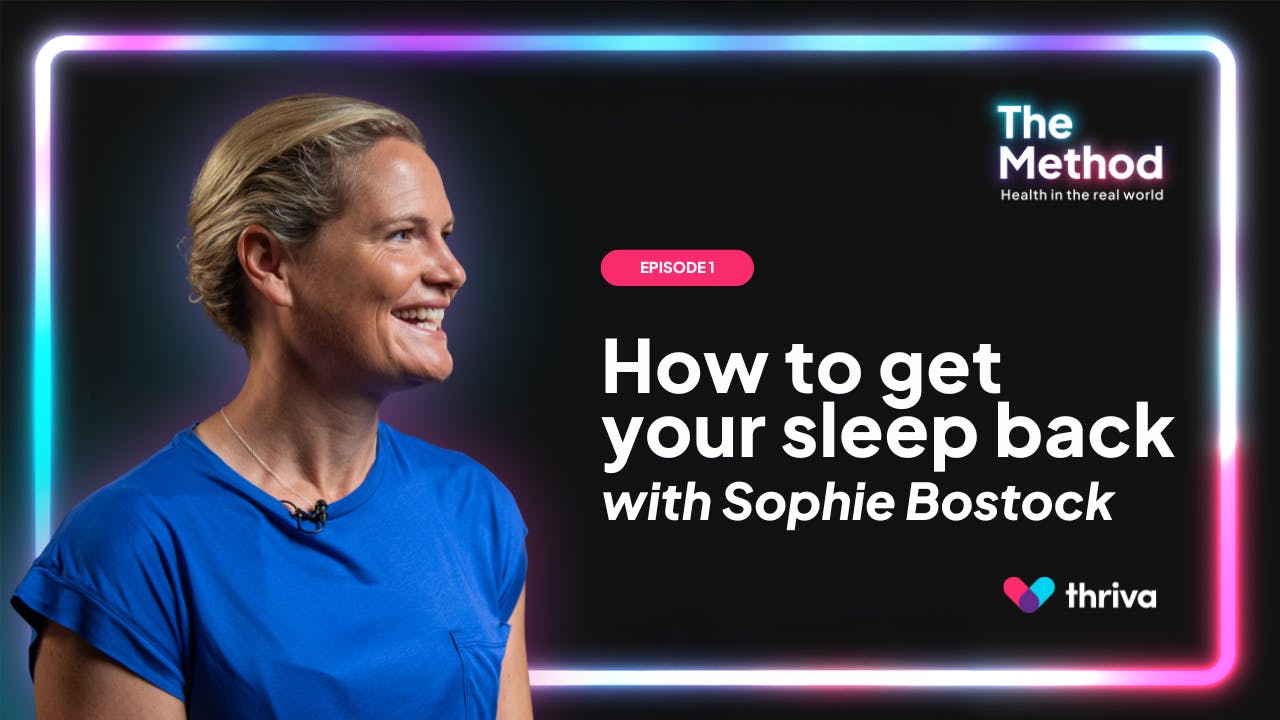
In our first episode of The Method, we sat down with sleep scientist Dr Sophie Bostock to understand what happens when we don’t get enough sleep, and how we can make good sleep a habit. She explained that we don’t always need to follow the generic guidelines. Some people function well on fewer than seven hours, while others feel better on more than nine.
Understanding this variability can allow you to have a healthier relationship with rest.
Track how much and how well you’re sleeping by integrating your wearable in the updated Thriva app.
Why do sleep needs vary from person to person?
Sophie emphasises that sleep needs vary considerably between people as well as within ourselves.
For example, you’ll need more sleep during a period of intense physical activity, like training for a marathon. Travel and jet lag also create disruption that takes time to recalibrate.
It also takes time to sort out the sleep debt you’ve accumulated. "You can't just pay it all back in one night," she said.
Genetics also come into play. Experts think that being a ‘morning person’ or ‘night owl’ is up to 50% heritable. However, your behaviour is a powerful tool. Keeping the lights on late at night if you’re a night owl will only strengthen your natural tendencies.
What happens to your brain during sleep
During deep sleep, your brain activates what scientists call the glymphatic system. This is a waste cleanup process that flushes out metabolic debris accumulated during the day.
Sophie describes this as your brain’s dishwasher: “You have these pulses of fluid that pass by all the cells,” she said. “They mop up or push out the dirty gunk that's been accumulating during the day."
Sleep also helps regulate systems throughout your body. When it's disrupted, you produce more ghrelin (the hunger hormone) and less leptin (the fullness hormone).
This impact on appetite can have a knock-on effect on your weight. According to research published in the Journal of the American College of Cardiology, sleep-restricted individuals consumed roughly 250 extra calories per day. While this might not sound like much, it can add up over time.
How sleep affects your mood and mental health
You’ve probably experienced feeling particularly irritable after a bad night’s sleep. And there’s science to explain why: sleep deprivation has a measurable impact on emotional regulation.
Sophie points to research showing that a single night without sleep can push some healthy people to clinical levels of anxiety. "The brain is being pushed into a state where it kind of feels unsafe," she explained.
Over time, this can create a vicious cycle. Poor sleep makes you more anxious, and anxiety makes it harder to sleep well.
A 2021 meta-analysis in Sleep confirmed this bidirectional relationship. It showed that sleep deprivation impairs emotional regulation, while negative emotional states lead to sleep disruption.
However, the relationship works in both directions. Improving your sleep can help improve your mood, and vice versa.
Practical strategies when sleep is disrupted
If you’re struggling with getting enough and consistent sleep, Sophie offers practical guidance grounded in research.
- Naps work, but keep them short: Aim for 20–30 minutes, ideally before 3 pm. It’s long enough to restore energy levels without impacting your night’s sleep.
- You can bank sleep before a tough stretch: If you have travel or a busy week at work on the horizon, try to get an extra hour in the nights beforehand.
- If you're awake at 3 am, get out of bed: Read something unstimulating, do a crossword, or watch some comfort TV. Once you feel sleepy again, get back into bed. This breaks the cycle of conditioned arousal that turns temporary insomnia chronic.
If there’s one take-home message you should ponder, it’s to go easy on yourself. “When we're sleep-deprived, our brain goes into this anxious state, this irritable state, and this self-critical state," Sophie explained. The critical voice in your head can become overwhelming.
Sophie's advice is to treat some of that self-criticism as a symptom, not a reflection of reality. "Even if you haven't got time to get extra sleep, you can be kind to yourself in other ways,” she said. “Take breaks during the day. Eat well. Try to restore the body in other ways."
Where to listen
For our full conversation with Dr Sophie Bostock, listen to The Method podcast.
- Bogan, R. et al. (2021). Efficacy and safety of calcium, magnesium, potassium, and sodium oxybates (lower-sodium oxybate [LXB]; JZP-258) in a placebo-controlled, double-blind, randomized withdrawal study in adults with narcolepsy with cataplexy. https://academic.oup.com/sleep/article/44/3/zsaa206/5923328
- Covassin, N. et al. (2022). Effects of Experimental Sleep Restriction on Energy Intake, Energy Expenditure, and Visceral Obesity. https://pubmed.ncbi.nlm.nih.gov/35361348/
- Hu, et al. (2016). GWAS of 89,283 individuals identifies genetic variants associated with self-reporting of being a morning person. https://www.nature.com/articles/ncomms10448