What we can learn from America’s new food pyramid
What's covered?



The U.S. has just released its new food pyramid and dietary guidelines for Americans. And while it's garnered plenty of media attention so far, we wanted to dig into what the guidance actually says.
Here’s our full breakdown of what it all means and what key takeaways you can apply to your own meals.
What the new U.S. dietary guidelines recommend
Its core message to eat real food, prioritise whole foods, and reduce highly processed foods is easy to get behind. Based on our analysis, these are the headline recommendations:
- Prioritise protein at every meal
- Consume 3 servings of full-fat dairy daily
- Cook with healthy fats like olive oil, with butter and beef tallow listed as alternatives
- Eat 3 servings of vegetables and 2 servings of fruit per day
- Include 2-4 servings of whole grains per day, and avoid white carbs
- Avoid added sugars and ultra-processed foods
Things get a bit confusing when you look at the guidance document and the visual food pyramid side by side. Meat and dairy products are featured prominently at the top of the pyramid, while whole grains and legumes get less attention.
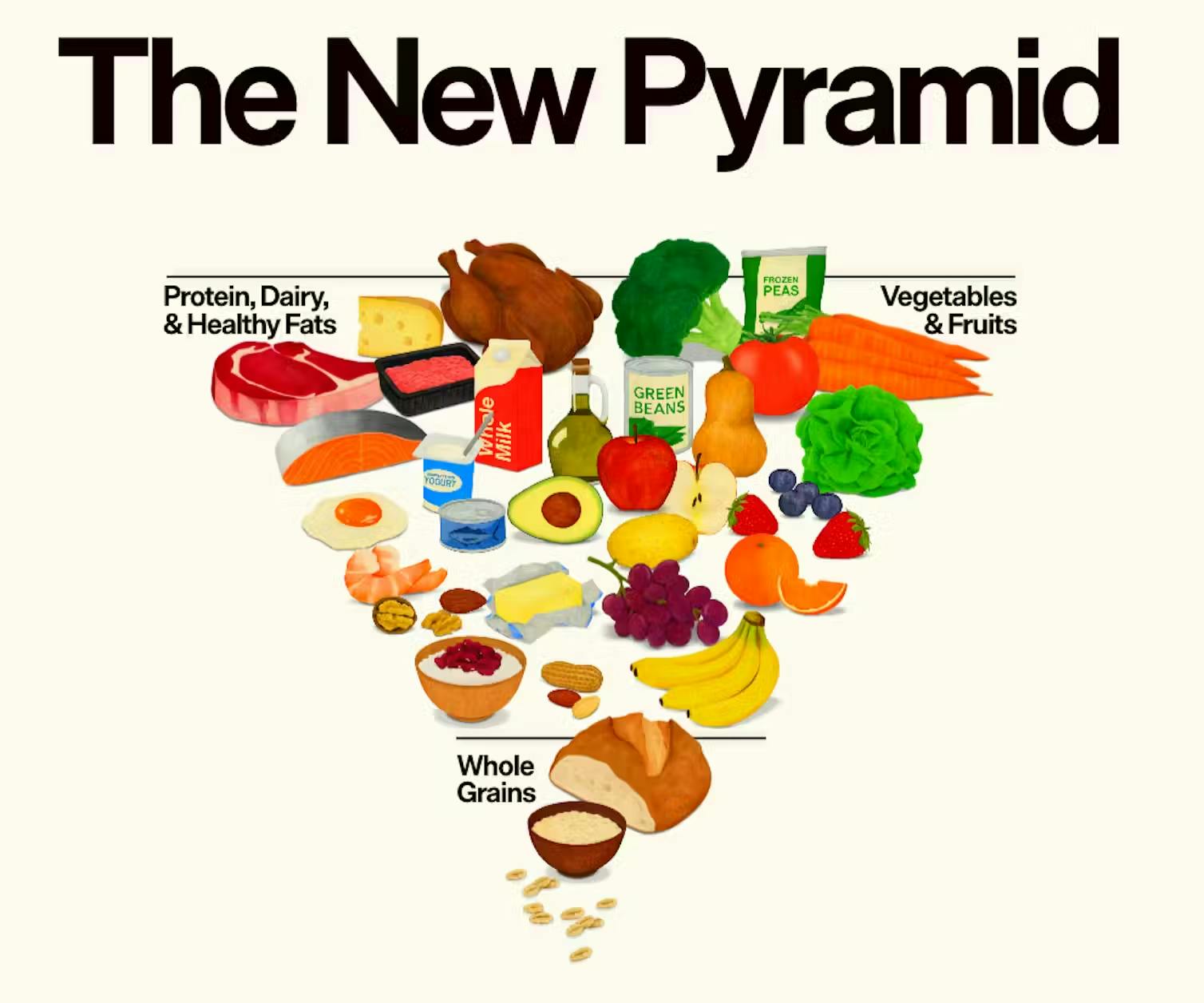
This doesn’t entirely match the guidance, which emphasises the importance of fibre and gut health. Despite this, we were happy that the gut got so much attention, as a healthy gut microbiome can support your digestion, immune system, and mental wellbeing.
What the guidelines get right
We’re in full support of the pyramid’s emphasis on whole foods. Organisations like the American Medical Association have spoken out in favour of its ‘food as medicine’ approach.
A focus on fruit and veg
Encouraging people to eat more plant foods is a good thing. We know that the fibre, micronutrients, and antioxidants in fruit and veg have plenty of health benefits, and most of us could benefit from eating more of them.
We particularly liked that when it came to fruit and veg, the guidelines factored in accessibility, which can often be ignored. They noted that frozen and canned (without added salt or sugar) options were healthy options that come with a lower price tag and longer shelf life.
Limiting added sugar
Additionally, the guidance recommended strictly limiting added sugars. While some of the wording could be seen as unrealistic for most people, the general message to reduce added sugar where possible is important, especially considering how much can be hiding in processed foods.
Varied guidance by life stage
The guidance gave individualised recommendations for different life stages, including pregnancy and lactation. Acknowledging that nutritional needs shift at different points in our lives is a crucial part of educating people about eating well.
Where they could use improvement
On a few occasions, the guidance didn’t quite match up with the visual food pyramid. And this led to some confusing contradictions that made the recommendations challenging to follow.
We’ve broken down what the research says and identified easy changes you can make to your own diet.
Keeping saturated fats in check matters
If you look at the updated pyramid, you’ll quickly notice the meat, full-fat dairy, and butter up top. However, the guidelines recommend keeping saturated fat below 10% of daily calories.
When you add up the amount of saturated fat in several daily servings of protein, three servings of full-fat dairy, and healthy fats, it’s easy to go above that 10% mark.
Despite this, the research shows that it’s important to keep saturated fats in check. There is strong evidence that replacing saturated fats (those that are solid at room temperature) with polyunsaturated fats (which are liquid at room temperature) is linked to a lower risk of cardiovascular disease.
Key takeaway: It’s a good idea to be mindful of your saturated fat intake, especially if you have elevated blood lipids (like LDL cholesterol or ApoB). You can reduce your saturated fat intake by choosing plant oils over animal fats and selecting less fatty cuts of meat. Try including foods rich in omega-3s, like fatty fish, a type of unsaturated fat linked to a lower risk of heart disease.
You don’t always need full-fat dairy
While this guidance encourages choosing full-fat dairy, the choice is highly individualised. For people who have high cholesterol or are trying to lose weight, lower-fat options have a valuable place.
The research on low-fat vs. full-fat isn’t black and white. Current research tells us that full-fat dairy isn’t meant to be feared or avoided, with multiple large studies showing that it doesn’t significantly impact the risk of developing cardiovascular disease.
But this doesn’t necessarily mean it should be strongly emphasised: the UK guidance takes a more ‘middle of the road’ stance that recommends choosing lower-fat options when you can.
Key takeaway: Full-fat dairy has benefits like being more satiating and sometimes containing less sugar than lower-fat options. Choose what works for you—that might mean opting for full-fat sometimes and picking a lower-fat option other times.
Legumes deserve a spot on your plate
Despite gut health getting a mention in the guidelines, beans and lentils didn’t get a spot on the food pyramid. These affordable, convenient pantry staples are an excellent source of both protein and fibre, which is an important consideration when we know that most people in the UK don’t consume enough fibre.
There’s strong evidence that higher fibre intake is linked to a lower risk of cardiovascular disease and type 2 diabetes and type 2 diabetes(Anderson et al., 2009; Becerra-Tomás et al., 2019). Alongside supporting digestive health and regularity, it can help you feel satiated, which can aid in managing your weight.
Key takeaway: It’s surprisingly hard to hit the 30 grams of fibre recommended for adults in the UK. Beans provide roughly 6-9 grams per half cup, making them a practical way to close the gap.
Why population guidelines are just the starting point
Broad dietary guidance is useful, but it can’t account for individual needs. Our needs can vary based on sex, life stage, and lifestyle. For example:
- Someone with elevated blood lipids (like ApoB and LDL cholesterol) might want to be more cautious with saturated fats.
- A post-menopausal woman might need to ensure she consumes enough protein, calcium, and vitamin D.
- A younger woman with low ferritin might benefit from eating more red meat.
This is where knowing your own biomarkers comes into play. They can tell you where your own needs might diverge from population-based guidelines, and where you might want to eat more or less of certain foods.
Takeaway
The new U.S. food guidelines get several things right: prioritising whole foods, emphasising gut health, and advising less added sugar.
However, things get complicated when it comes to saturated fat and fibre.
While there are valuable takeaways we can learn from this food pyramid, it’s also a good reminder that population guidance isn’t a one-size-fits-all solution.
Disclaimer: This information is for general educational purposes only and isn’t a substitute for professional medical advice, diagnosis, or treatment. Always speak with a qualified healthcare professional first if you have concerns about your health.
- Abeltino, A. et al. (2024). Unraveling the Gut Microbiota: Implications for Precision Nutrition and Personalized Medicine. https://www.mdpi.com/2072-6643/16/22/3806
- American Medical Association. (2026). AMA applauds Dietary Guidelines, announces commitments on nutrition. https://www.ama-assn.org/press-center/ama-press-releases/ama-applauds-dietary-guidelines-announces-commitments-nutrition
- Barber, T. M. et al. (2020). The health benefits of dietary fibre. https://www.mdpi.com/2072-6643/12/10/3209
- British Dietetic Association. (2021). Fibre. https://www.bda.uk.com/resource/fibre.html
- Lamarche, B. et al. (2025). Regular-fat and low-fat dairy foods and cardiovascular diseases: perspectives for future dietary recommendations. https://doi.org/10.1016/j.ajcnut.2025.03.009
- Maki, K., Dicklin, M. & Kirkpatrick, C. (2021). Saturated fats and cardiovascular health: Current evidence and controversies. https://www.sciencedirect.com/science/article/abs/pii/S193328742100248
- Public Health England. (2019). Saturated fats and health: SACN report. https://www.gov.uk/government/publications/saturated-fats-and-health-sacn-report
- Reynolds, A. et al. (2019). Carbohydrate quality and human health: a series of systematic reviews and meta-analyses. https://www.thelancet.com/article/S0140-6736%2818%2931809-9/fulltext
- Sacks, F. et al. (2017). Dietary Fats and Cardiovascular Disease: A Presidential Advisory From the American Heart Association. https://doi.org/10.1161/cir.0000000000000510
- The Food Foundation. (2025). UK still failing to meet basic dietary guidelines. https://foodfoundation.org.uk/news/uk-still-failing-meet-basic-dietary-guidelines
- USDA. (2025). Dietary Guidelines for Americans. https://cdn.realfood.gov/DGA.pdf
- Wallace, T. et al. (2019). Fruits, vegetables, and health: A comprehensive narrative, umbrella review of the science and recommendations for enhanced public policy to improve intake. https://www.tandfonline.com/doi/full/10.1080/10408398.2019.1632258