Capillary blood sampling: A reliable method for at-home PSA testing



Capillary blood sampling has the potential to greatly expand access to healthcare. By facilitating diagnostic tests at home or at convenient, easily accessible locations, these methods have the capacity to improve detection rates and enable more effective disease monitoring.
This is especially important for diseases like prostate cancer, which is anticipated to affect twice the number of individuals by 2040. A critical biomarker used in diagnosing this disease is Prostate Specific Antigen (PSA). Early detection of prostate cancer through PSA testing can facilitate earlier treatment, potentially leading to significantly improved outcomes.
To assess the accuracy of PSA tests in capillary samples versus venous tests, our internal clinical team conducted a comprehensive proof-of-principle study to delve deeper into this matter.
Study design
The purpose of this study was to validate the accuracy of capillary blood samples collected using capillary serum separator (SST) microtainer tubes in comparison to venous samples collected with SST tubes, which are typically considered the gold standard. The participants in the study comprised a mix of disease-free individuals and men with known prostate cancer. Paired venous and capillary samples were collected and tested to evaluate their comparability.
Additionally, the samples were tested on two analysers (a Roche and a Beckman analyser) to identify any differences that could impact their usability. To assess stability, an additional capillary sample was collected and analysed after a period of 8 days to simulate carriage and transport through the postal system before an external clinical pathologist reviewed and verified the results to ensure accuracy.
The study was conducted alongside Timothy Woolley, Chief Scientific Officer of one of our partners Inuvi Diagnostics, which holds UKAS accreditation for PSA on venous and capillary blood.
Study findings
A diverse range of PSA levels, spanning from low to high levels, was successfully obtained by including both healthy participants and those with prostate cancer. The study demonstrated that PSA results were consistently interchangeable between capillary and venous samples across the entire range of results. Furthermore, the impact of using two different analysers was negligible, indicating that both analysers could be utilised for PSA testing in capillary samples.
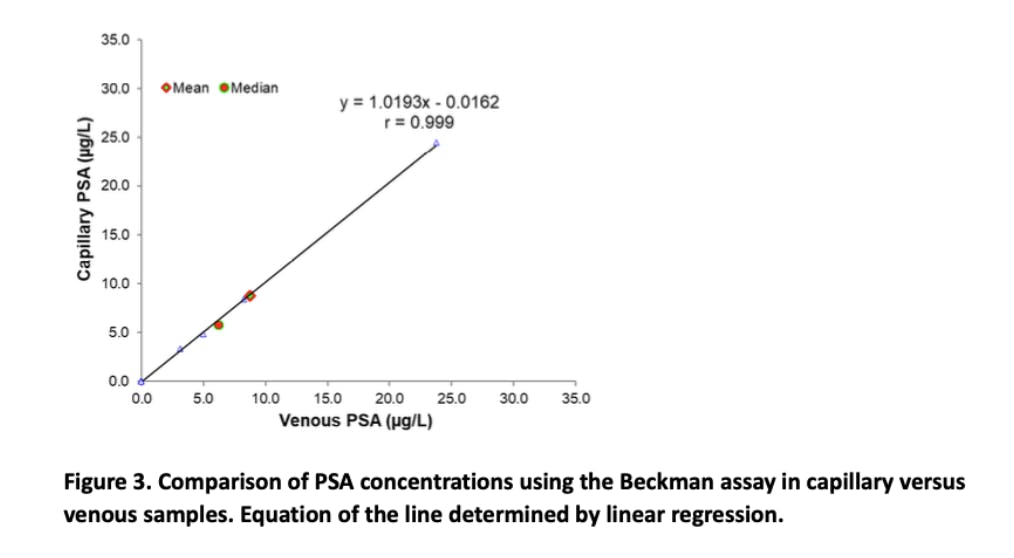
PSA levels obtained through capillary blood samples were found to remain stable for up to 8 days, indicating that even if samples were delayed in the post, they could still be relied upon to yield valid results.
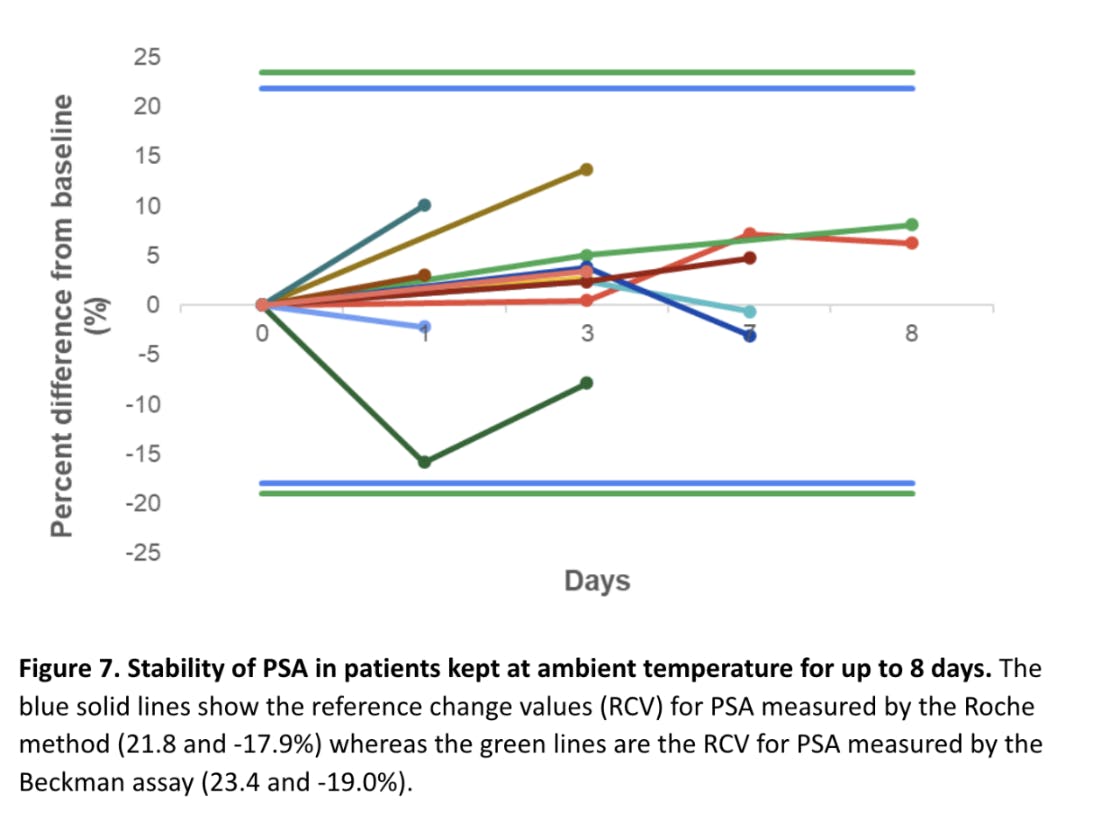
The blue solid lines show the reference change values (RCV) for PSA measured by the Roche method (21.8 and -17.9%), whereas the green lines are the RCV for PSA measured by the Beckman assay (23.4 and -19.0%).
Conclusions
Based on this study, capillary testing of PSA has been shown to be accurate, reliable, and demonstrated good stability. We believe that this study can lay the groundwork for future research, ultimately contributing to increased accessibility of PSA testing and leading to improved outcomes.
Want to learn more? Get in touch with a member of the Thriva for Partners team today.